Demystifying Database Sharding: Guide to Horizontal Scaling at Mass Scale
As developers stepping into backend architecture and system design, we often hit a performance wall that standard optimizations simply can’t fix. You’ve added indexes to your database, you’ve implemented Redis caching for hot read paths, and you’ve set up primary-replica replication to offload query traffic.
Then comes a massive spike in user growth.
Suddenly, your database primary is handling millions of write operations every hour. Disks are filling up, write locks are queueing up, and memory usage is pinned at 99%. Replicas can’t save you here—because while replicas scale reads, every single write operation still has to hit your primary database instance.
When you hit the physical write limits of a single database machine, you enter the domain of Database Sharding.
In this deep dive, we’re going to dissect database sharding from the ground up: what it is, how it differs from traditional partitioning, the core sharding strategies, key mathematical algorithms like Consistent Hashing, and the real-world trade-offs you must navigate when breaking apart your data layer.
1. What is Database Sharding? (Vertical vs. Horizontal Scaling)
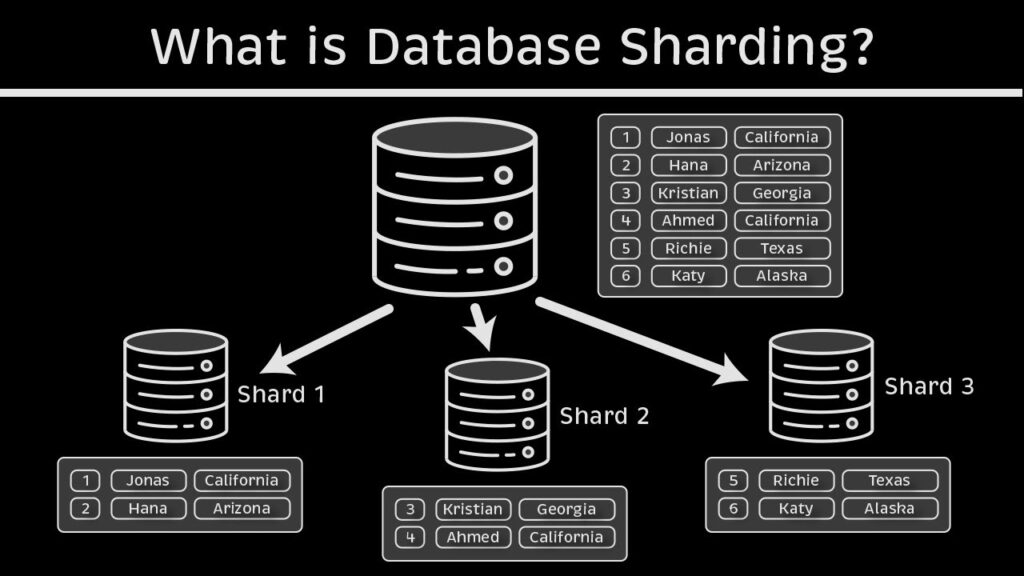
At its core, Sharding is a method of horizontally partitioning a database into smaller, independent chunks called shards. Each shard is a separate, self-contained database hosted on its own distinct server instance.
To understand sharding, let’s contrast it with the two classic ways of scaling databases:
                      DATABASE SCALING PATHS

      ┌────────────────────────────────────────────────────┐
      │             Single Monolithic Database             │
      └─────────────────────────┬──────────────────────────┘
                                │
          ┌─────────────────────┴─────────────────────┐
          ▼                                           ▼
┌──────────────────┐                        ┌──────────────────┐
│ Vertical Scaling │                        │ Sharding (Horiz) │
│ (Bigger Server)  │                        │  (Split Data)    │
└──────────────────┘                        └─────────┬────────┘
                                                      │
                                        ┌─────────────┴─────────────┐
                                        ▼                           ▼
                             ┌─────────────────────┐     ┌─────────────────────┐
                             │  Database Server A  │     │  Database Server B  │
                             │   (Users A - M)     │     │   (Users N - Z)     │
                             └─────────────────────┘     └─────────────────────┘
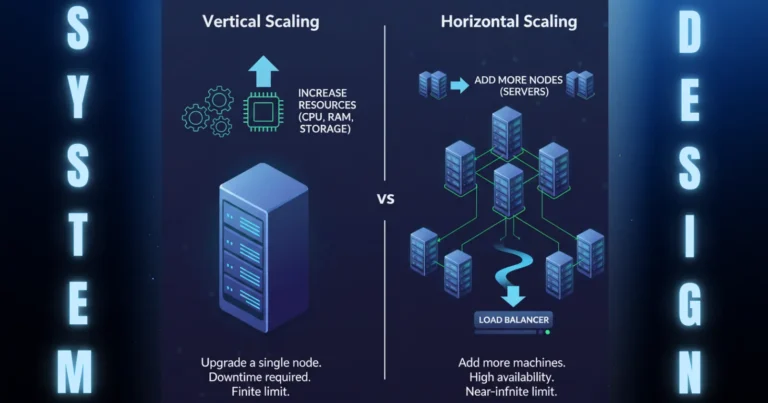
Vertical Scaling (Scaling Up)
You buy a machine with more CPU cores, faster NVMe storage, and 512 GB of RAM.
- Pros: Simple. No code changes required.
- Cons: Extremely expensive, and you will eventually hit a hard hardware limit. There is no physical machine in the world that can run a single 500 TB database with 100,000 concurrent write operations per second.
Vertical Partitioning
You separate distinct tables across different database servers based on domain. For instance, put the Users table on Database 1, the Orders table on Database 2, and the Analytics table on Database 3.
- Pros: Helps isolate domain traffic.
- Cons: If a single table (like
Orders) grows to 10 billion rows, vertical partitioning fails to solve the scaling bottleneck for that specific table.
Horizontal Partitioning (Sharding)
Instead of splitting by tables, Sharding splits a single table across multiple database engines.
For example, an Orders table containing 100 million rows is split into 10 separate database servers, each holding 10 million rows. Each server contains the exact same schema, but holds a mutually exclusive subset of the total dataset.
Together, these independent shards form a logical whole to the application, but physically, they run on completely decoupled hardware.
2. Anatomy of a Sharded Architecture
How does an application know which database server holds a specific record?
A sharded setup introduces two critical concepts: the Shard Key and the Routing Layer.
                           ┌──────────────┐
                           │ App / Client │
                           └──────┬───────┘
                                  │
                                  ▼
                        ┌──────────────────┐
                        │ Router / Gateway │
                        │  (Computes Key)  │
                        └─────────┬────────┘
                                  │
          ┌───────────────────────┼───────────────────────┐
          │                       │                       │
          ▼                       ▼                       ▼
┌──────────────────┐    ┌──────────────────┐    ┌──────────────────┐
│     Shard 1      │    │     Shard 2      │    │     Shard 3      │
│  (Users 1 - 1M)  │    │ (Users 1M - 2M)  │    │ (Users 2M - 3M)  │
└──────────────────┘ └──────────────────┘ └──────────────────┘- The Shard Key: A specific field or column present in your data rows (e.g.,
user_id,country_code, ortenant_id) that determines how data is distributed. - The Router / Routing Layer: An intelligent middleware or database driver layer that inspects incoming queries, evaluates the shard key, computes the target shard’s address, and forwards the query to the correct physical database instance.
3. Sharding Strategies & Routing Algorithms
Selecting the right sharding strategy is the single most important decision when architecting a distributed data tier. A bad strategy leads to uneven data distribution, deadlocks, and severe performance bottlenecks.
Let’s look at the four primary sharding strategies.
Strategy 1: Key-Based (Hash-Based) Sharding
Hash-based sharding applies a hashing algorithm (like MD5, MurmurHash, or SHA-256) to the shard key, takes the resulting integer, and calculates the modulo against the total number of shards ($N$).
$$\text{Shard ID} = \text{Hash}(\text{Shard Key}) \pmod N$$
User ID: "usr_9482" ──> Hash Function ──> 84,729,102 ──> % 4 Shards ──> Shard 2- Pros: Ensures an extremely uniform distribution of data across all shards, minimizing the risk of uneven disk usage.
- Cons: Re-sharding is disastrous. If you start with 4 shards ($N=4$) and need to add a 5th shard ($N=5$), the output of the modulo operator changes for almost every single key in your database. Adding one server requires migrating up to 80% of your total data across servers!
Strategy 2: Range-Based Sharding
Range-based sharding partitions data based on continuous ranges of a specific feature value.
       Range: A - G            Range: H - O            Range: P - Z
   ┌──────────────────┐    ┌──────────────────┐    ┌──────────────────┐
   │     Shard 1      │    │     Shard 2      │    │     Shard 3      │
   └──────────────────┘    └──────────────────┘    └──────────────────┘
For example, splitting an e-commerce catalog based on product_id:
- Shard 1: IDs 1 to 1,000,000
- Shard 2: IDs 1,000,001 to 2,000,000
- Shard 3: IDs 2,000,001 to 3,000,000
- Pros: Conceptually simple to implement and query. Range queries (e.g.,
SELECT * FROM orders WHERE order_id BETWEEN 500 AND 1500) can be easily routed without querying every node. - Cons: High risk of Hotspots. If you shard by auto-incrementing timestamps or IDs, all new writes will hit the newest shard exclusively while older shards sit completely idle.
Strategy 3: Directory-Based (Lookup) Sharding
In directory-based sharding, a central lookup service or mapping table maintains the explicit connection between a Shard Key and its physical host machine.
                        ┌────────────────────┐
                        │   Directory Map    │
                        ├──────────┬─────────┤
                        │ Customer │ Shard ID│
                        ├──────────┼─────────┤
                        │ Apple    │ Shard A │
                        │ Google   │ Shard B │
                        │ Stripe   │ Shard A │
└──────────┴─────────┘- Pros: Highly flexible. It makes re-balancing datasets straightforward because you can move a customer’s entire data partition to a larger server and simply update a single entry in the lookup table.
- Cons: The lookup table becomes a critical Single Point of Failure (SPOF) and performance bottleneck. Every single read and write query must query the lookup directory first before touching the database.
Strategy 4: Geo-Based (Directory / Locality) Sharding
Geo-sharding partitions data based on geographic region or jurisdiction (e.g., country_code or region).
- Shard 1 (EU Region): Hosts European user data in Frankfurt data centers.
- Shard 2 (US Region): Hosts American user data in Virginia data centers.
- Shard 3 (APAC Region): Hosts Asian user data in Singapore data centers.
- Pros:
- Low Latency: Data lives physically close to the end-users accessing it.
- Regulatory Compliance: Easily satisfies strict data sovereignty laws (like GDPR in Europe) that mandate citizen data cannot leave regional borders.
- Cons: Uneven load. Traffic patterns fluctuate wildly across time zones, leaving some shards underutilized while others peak.
4. Solving the Re-Sharding Problem: Consistent Hashing
As noted earlier, traditional Hash-Based Sharding ($\text{Hash}(K) \pmod N$) breaks down when you need to dynamically add or remove servers. To solve this, distributed systems use Consistent Hashing.
How Consistent Hashing Works
- The Hash Ring: Imagine a mathematical circle (hash ring) mapped from $0$ to $2^{32} – 1$.
- Mapping Nodes: Server nodes are hashed based on their IP addresses and placed at specific points along the circle.
- Mapping Keys: When a record key needs to be stored, it is hashed and placed on the circle.
- Routing Rule: The record is assigned to the first server encountered by moving clockwise around the ring.
                       [ 0 / 2^32 ]
                     /              \
         (Server A) O                O (Key 1) --> Routes to Server B
                   /                  \
                  |                    |
         (Key 3) O                     O (Server B)
                  |                    |
                   \                  /
         (Server C) O                O (Key 2) --> Routes to Server C
                     \              /
                       \__________/
Why Consistent Hashing Wins:
When you add a new server node to the ring, only the keys that fall between the new node and its immediate predecessor need to be moved. The rest of the keys across the entire database network stay exactly where they are.
This reduces data migration costs from 80%+ down to $1/N$ of the total dataset!
5. The Hard Reality: Real-World Trade-Offs & Challenges
While sharding solves massive horizontal scaling challenges, it introduces significant technical complexity into your application layer.
+-------------------------------------------------------------------+
|                     THE SHARDING TRADE-OFF                        |
+-------------------------------------------------------------------+
|  BENEFITS                          DRAWBACKS                      |
|  - Infinite Horizontal Scale       - No Cross-Shard Joins         |
|  - High Write Throughput           - Broken Referential Integrity |
|  - Isolated Failure Domains        - Complex Global Uniqueness    |
|  - Smaller Storage Footprints      - Re-balancing Overhead        |
+-------------------------------------------------------------------+
Problem 1: No Cross-Shard Joins
In a monolithic SQL database, executing a JOIN across Users, Orders, and Payments takes milliseconds.
In a sharded architecture, if Users live on Shard A and Orders live on Shard B, SQL JOIN queries are physically impossible at the database engine level.
To handle this, developers must either:
- Execute separate queries to Shard A and Shard B and join the arrays in application memory (Node.js/Go/Python layer).
- Denormalize schemas by duplicating data across tables to avoid the need for joins entirely.
Problem 2: Loss of ACID Transactions Across Shards
Standard databases provide ACID (Atomicity, Consistency, Isolation, Durability) guarantees for transactions within a single machine.
Once a transaction spans multiple physical database servers (e.g., transferring funds from User 1 on Shard A to User 2 on Shard B), a standard local transaction cannot ensure atomicity.
You are forced to implement complex distributed transaction protocols like Two-Phase Commit (2PC) or asynchronous patterns like the Saga Pattern, which sacrifice speed for eventual consistency.
Problem 3: Enforcing Global Uniqueness
In a non-sharded database, you rely on AUTO_INCREMENT primary keys ($1, 2, 3…$) or unique indexes.
In a sharded setup, if Shard 1 and Shard 2 both independently auto-increment their local primary keys, you will collide with duplicate primary keys when consolidating logs or serving client requests.
Solutions for Global IDs:
- UUIDs (v4/v7): 128-bit universally unique identifiers. (Downside: Larger indexing size).
- Snowflake IDs (Twitter Snowflake): 64-bit time-ordered integer IDs generated using a bitwise combination of Epoch Timestamp + Worker Node ID + Sequence Counter.
Problem 4: The “Hotspot” (Celebrity) Problem
What happens if your shard key is user_id, and a viral celebrity (with 50 million followers) gets assigned to Shard 4?
Every time that celebrity posts or receives interaction, Shard 4 will be overwhelmed with traffic while Shard 1, 2, and 3 sit underutilized. Dealing with hotspots requires setting up dedicated high-capacity shards for high-traffic keys or combining the primary shard key with a random salt.
6. Should You Shard? A Decision Framework
Sharding should almost never be your first option. It introduces immense operational, architectural, and debugging overhead.
Before committing to a sharded architecture, evaluate this checklist:
┌─────────────────────────────────────────────────────────┐
│              Database Performance Check                 │
└────────────────────────────┬────────────────────────────┘
                             │
                             ▼
                 /───────────────────────\
                < Have you optimized DB   >───[ NO ]───> Apply Indexes / Clean Queries
                 \  indexes & queries?   /
                  \─────────────────────/
                             │ YES
                             ▼
                 /───────────────────────\
                <  Have you added Redis   >───[ NO ]───> Cache Heavy Read Paths
                 \    caching layers?    /
                  \─────────────────────/
                             │ YES
                             ▼
                 /───────────────────────\
                <   Have you separated    >───[ NO ]───> Add Read-Replicas
                 \     Read/Write?       /
                  \─────────────────────/
                             │ YES
                             ▼
                 /───────────────────────\
                < Have you maxed out your >───[ NO ]───> Upgrade Machine Hardware
                 \  vertical hardware?   /
                  \─────────────────────/
                             │ YES
                             ▼
             ┌──────────────────────────────┐
             │ TIME TO IMPLEMENT SHARDING!  │
             └──────────────────────────────┘
If you have exhausted index optimization, caching, read-replicas, and vertical hardware limits—and your write traffic continues to overwhelm your data tier—then database sharding is your ultimate solution for scaling to internet-grade throughput.
Conclusion
Sharding is the foundation that allows modern tech giants—from global e-commerce platforms to massive social networks—to store petabytes of user data and process hundreds of thousands of transactions every second.
By partitioning data based on intelligent Shard Keys and leveraging patterns like Consistent Hashing, you can construct a distributed database tier capable of scaling horizontally without limits.
Have you worked with sharded databases like MongoDB Sharded Clusters, Vitess, or CockroachDB in your projects? Drop your experiences or questions in the comments below!

25 year old AI & MERN Stack Developer based in Mohali, Punjab, India, with a strong interest in system design, Artificial Intelligence, Large Language Models (LLMs), and scalable software architecture. Passionate about building innovative, intelligent, and high-performance applications.